Fulford Creative |
  • Twitter
  • Facebook
  • LinkedIn
  • Tumblr
  • Contact
Fulford Creative

  • the Man
  • the Biz
  • the Portfolio
    • Video & Multimedia
    • Branded Entertainment
    • Web
    • Print
  • the Stories
    • Fiction/Screenplays
    • Short Films
  • the Blog
  • the Links

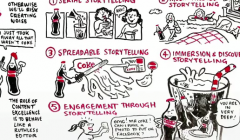
Coca Cola Content Post

Coca Cola Content 2020

Posted on November 8, 2011 by fulfordcreative

Great ideas on content, conversation models, storytelling, and themes of living positively from an unhealthy, dental eroding, and addictive product, and a company with a poor environmental record, questionable labor practices, and monopolistic business practices.

You can’t argue this much however: For over 100 years, Coca Cola has proven it can tell a damn good story.

This awesome video was animated by Cognitive Media, an animation studio based in Folkestone, Kent in the UK. Their mission is to help people to discover and learn new stuff with the help of storytelling, drawing and animation.


Share

Marketing With Humor Works

Posted on July 12, 2011 by fulfordcreative

Some say: Don’t even attempt incorporating humor into your marketing plan. It’s too subjective. Some might think it’s funny, others might be offended.

I say: Phooey

Who says a poop joke can’t be part of a marketing promotion?

Let’s look at the Poop Fairy campaign in the link above. It’s simple. It’s clever, kind of a potty joke but not too dirty. It elicits giggles if not laughter. Yeah, the Legend of the Poop Fairy might go a little too far (never overplay a joke). But the overall idea is great. It’s silly AND contains real education on dog waste and appeals to our sense of community as well.

Others say: You shouldn’t use humorous marketing ideas if you’re focused on selling or getting people to do something. It’s too likely to misfire rather than work as intended.

I say: Malarky!

Blendtec wants people to buy their blenders. So what do they do? They develop a hilarious campaign that SHOWS their blenders in action. Sales of Blendtec’s blenders have exploded out of the uh, blender, with its always entertaining Will it Blend web series. It’s goofy. It’s funny. Who wouldn’t want to see what happens when you put an iphone in a blender? Like I said, sales of Blendtec blenders are skyrocketing since the campaign launched several years ago.

Humor also works in B2B. IBM’s viral video Mainframe: The Art of the Sale, Lesson One is a good example of a clever way to promote your business while gently poking fun, as is a video I wrote for HP called the HP King of Cowbell. In this realm, the mockumentary approach really works well in that it’s easy and relatable to poke fun at the business environment. We can thank “The Office” TV show for that.

5 MORE reasons to add humor when promoting your brand:

- Breaks through the clutter
- Promotes customer loyalty
- Shows that you’re a confident company (willing to poke fun at yourself)
- Great way to spread a message (word-of-mouth marketing)
- Great way to make your message more receptive

Michigan-based Moosejaw has built a loyal following by with its outrageous marketing efforts, leveraging the company’s mail order catalog, website and branded blog, through its hilarious and nonsensical marketing vision executives call “The Madness.” Blogger Ralph Paglia profiles the company here “Humor Can Be Your Best Targeted Marketing Strategy.”

Data shows that people take action to follow experiences that make them laugh. Whether it works for your brand depends on your creative vision, the writing, and the needs and interests of your audience.

Share

This is Slappin’ the Bass

Posted on July 7, 2011 by fulfordcreative

Old soundie found on the Internet Archive of Reg Kehoe and his Marimba Queens. Stealing the show and showing us that even bass players can bang their heads is ‘hep-cat’ bassist Frank DeNunzio, Sr., of Hershey, Pennsylvania, who played his standup–slap bass almost until his death in February 2005.

Share
Paranoid Android Video

Videos of the Week – Music Edition

Posted on June 24, 2011 by fulfordcreative

Talented yet undiscovered musicians are finding viral success by posting their videos on YouTube and other video sharing sites. Some artists are really good, others might have a career in comedy. Here are the best of the week:

Freddie25 and his clones do a GREAT Queen cover.

YouTube musicians stitched together playing a collaborative version of Radiohead’s Paranoid Android.

A fun trend in YouTube videos are “literal” translations of the action seen in the video. Like this one explaining the on-screen action of the Red Hot Chili Peppers (Under the Bridge). Here we see a video game trailer made into a music video, with the action being narrated exactly as we see it.

Pro golfers form boy band, and rap badly.

And for your dancing pleasure, a gorilla at the Calgary Zoo throws down some sweet electric boogaloo.

Share
Flash Fiction

What the heck is Flash Fiction?

Posted on June 23, 2011 by fulfordcreative

Hearing a lot about Flash Fiction these days. I’m picturing short little stories that briefly pull open their overcoat and expose themselves to a shocked and disgusted audience.

But it seems it’s getting more, um, exposure (decent or not). It’s now a commercial entity now that the internet has successfully squeezed the pulp out of our collective attention span. Editors at online publications are looking for shorter works to meet the demands of our wandering, unfocused, meandering, taking a stroll in the park, that one near the zoo, right downtown, yeah, the one in Chicago, right in the middle of the city, do you think the animals like being in a busy downtown environment, wait, what was I talking about?

Flash Fiction are tales on the small end, between 300 and 1,000 words. To compare, short stories in publications like the New Yorker or Esquire typically run 3,000 to 5,000 words. Flash Fiction can be an in the moment story or a rehashing of multiple events. It’s a compressed tale where the tiniest movement matters. It’s a sudden realization that needs to be told. It’s so short that there’s no margin for error. Every word is essential. Every letter must be in the exact rihgt place.

The most widely-accepted example of flash fiction is a short, short, really short story by Ernest Hemingway:

“For sale: baby shoes. Never worn.”

Did you hear that? That was my imagination opening then slamming shut almost simultaneously.

I recently found a cool Sci Fi Flash Fiction site called 365 Tomorrows. I like sci fi, and I like short fiction. So I like the stories on this site. Here’s what these folks say about themselves.

“365 tomorrows is a collaborative project designed to present readers with a new piece of short science and speculative ‘flash’ fiction each day. Launched August 1st 2005 with the lofty goal of providing a new story every day for a year. We’ve been on the wire ever since.”

There are Flash Fiction contests, Flash FanFiction, Flash Non-Fiction, Flash Novels, you name it. Check out my own Flash Fiction attempt on my storytelling page here.


Share
Picture Hero Journey Suitcase

Joseph Campbell Snippets

Posted on June 16, 2011 by fulfordcreative

Quotes from Joseph Campbell:

***

The goal of life is to make your heartbeat match the beat of the universe, to match your nature with Nature.

***

The goal of your quest for knowledge is to be found at that burning point in yourself, that becoming thing in yourself, which is innocent of the goods and evils of the world as already become, and therefore desireless and fearless. That is the condition of a warrior going into battle with perfect courage. That is life in movement.

***

Myths and dreams are manifestations in image form (metaphors) of all of the energies of the body, moved by the organs, in conflict with each other.

***

A bit of advice given to a young Native American at the time of his initiation:

“As you go the way of life, you will see a great chasm.

Jump.

It’s not as wide as you think.”

***

The warrior’s approach is to say “yes” to life: “yea” to it all.

***

Nothing is routine, nothing is taken for granted. Everything is standing out on it’s own, because everything is a possibility, everything is a clue, everything is talking to you. It’s marvelous.

***
I don’t think of God as up there. I think of God as right here in whatever I’m knowing and loving and serving.

***

It’s very difficult to find in the outside world something that matches what the system inside of you is yearning for.

***

(Han) Solo was a very practical guy, at least as he thought of himself, a materialist. But he was a compassionate human being at the same time and didn’t know it. The adventure evoked a quality of his character that he hadn’t known he possessed.

***

MOYERS: What about this idea of good and evil in mythology, of life as a conflict between the forces of darkness and light?

CAMPBELL: That is a Zoroastrian idea, which has come over into Judaism and Christianity. In other traditions, good and evil are relative to the position in which you are standing. What is good for one is evil for the other. And you play your part, not withdrawing from the world when you realize how horrible it is, but seeing that this horror is simply the foreground of a wonder: a mysterium tremendum et fascinans.


Share
Lester Dent

Lester Dent Pulp Fiction Formula

Posted on June 7, 2011 by fulfordcreative

Lester Dent Pulp Fiction Formula

By Lester Dent

This is a formula, a master plot, for any 6000 word pulp story. It has worked on adventure, detective, western and war-air. It tells exactly where to put everything. It shows definitely just what must happen in each successive thousand words.

No yarn of mine written to the formula has yet failed to sell.

The business of building stories seems not much different from the business of building anything else.

Here’s how it starts:

1. A DIFFERENT MURDER METHOD FOR VILLAIN TO USE
2. A DIFFERENT THING FOR VILLAIN TO BE SEEKING
3. A DIFFERENT LOCALE
4. A MENACE WHICH IS TO HANG LIKE A CLOUD OVER HERO

One of these DIFFERENT things would be nice, two better, three swell. It may help if they are fully in mind before tackling the rest.

A different murder method could be–different. Thinking of shooting, knifing, hydrocyanic, garroting, poison needles, scorpions, a few others, and writing them on paper gets them where they may suggest something. Scorpions and their poison bite? Maybe mosquitos or flies treated with deadly germs?

If the victims are killed by ordinary methods, but found under strange and identical circumstances each time, it might serve, the reader of course not knowing until the end, that the method of murder is ordinary.

Scribes who have their villain’s victims found with butterflies, spiders or bats stamped on them could conceivably be flirting with this gag.

Probably it won’t do a lot of good to be too odd, fanciful or grotesque with murder methods.

The different thing for the villain to be after might be something other than jewels, the stolen bank loot, the pearls, or some other old ones.

Here, again one might get too bizarre.

Unique locale? Easy. Selecting one that fits in with the murder method and the treasure–thing that villain wants–makes it simpler, and it’s
also nice to use a familiar one, a place where you’ve lived or worked. So many pulpateers don’t. It sometimes saves embarrassment to know nearly as much about the locale as the editor, or enough to fool him.

Here’s a nifty much used in faking local color. For a story laid in Egypt, say, author finds a book titled “Conversational Egyptian Easily Learned,” or something like that. He wants a character to ask in Egyptian, “What’s the matter?” He looks in the book and finds, “El khabar, eyh?” To keep the reader from getting dizzy, it’s perhaps wise to make it clear in some fashion, just what that means. Occasionally the text will tell this, or someone can repeat it in English. But it’s a doubtful move to stop and tell the reader in so many words the English translation.

The writer learns they have palm trees in Egypt. He looks in the book, finds the Egyptian for palm trees, and uses that. This kids editors and readers into thinking he knows something about Egypt.

Here’s the second installment of the master plot.

Divide the 6000 word yarn into four 1500 word parts. In each 1500 word part, put the following:

FIRST 1500 WORDS

1–First line, or as near thereto as possible, introduce the hero and swat him with a fistful of trouble. Hint at a mystery, a menace or a problem to be solved–something the hero has to cope with.

2–The hero pitches in to cope with his fistful of trouble. (He tries to fathom the mystery, defeat the menace, or solve the problem.)

3–Introduce ALL the other characters as soon as possible. Bring them on in action.

4–Hero’s endevours land him in an actual physical conflict near the end of the first 1500 words.

5–Near the end of first 1500 words, there is a complete surprise twist in the plot development.

SO FAR: Does it have SUSPENSE?
Is there a MENACE to the hero?
Does everything happen logically?

At this point, it might help to recall that action should do something besides advance the hero over the scenery. Suppose the hero has learned the dastards of villains have seized somebody named Eloise, who can explain the secret of what is behind all these sinister events. The hero corners villains, they fight, and villains get away. Not so hot.

Hero should accomplish something with his tearing around, if only to rescue Eloise, and surprise! Eloise is a ring-tailed monkey. The hero counts the rings on Eloise’s tail, if nothing better comes to mind.
They’re not real. The rings are painted there. Why?

SECOND 1500 WORDS

1–Shovel more grief onto the hero.

2–Hero, being heroic, struggles, and his struggles lead up to:

3–Another physical conflict.

4–A surprising plot twist to end the 1500 words.

NOW: Does second part have SUSPENSE?
Does the MENACE grow like a black cloud?
Is the hero getting it in the neck?
Is the second part logical?

DON’T TELL ABOUT IT***Show how the thing looked. This is one of the secrets of writing; never tell the reader–show him. (He trembles, roving eyes, slackened jaw, and such.) MAKE THE READER SEE HIM.

When writing, it helps to get at least one minor surprise to the printed page. It is reasonable to to expect these minor surprises to sort of inveigle the reader into keeping on. They need not be such profound efforts. One method of accomplishing one now and then is to be gently misleading. Hero is examining the murder room. The door behind him begins slowly to open. He does not see it. He conducts his examination blissfully. Door eases open, wider and wider, until–surprise! The glass pane falls out of the big window across the room. It must have fallen slowly, and air blowing into the room caused the door to open. Then what the heck made the pane fall so slowly? More mystery.

Characterizing a story actor consists of giving him some things which make him stick in the reader’s mind. TAG HIM.

BUILD YOUR PLOTS SO THAT ACTION CAN BE CONTINUOUS.

THIRD 1500 WORDS

1–Shovel the grief onto the hero.

2–Hero makes some headway, and corners the villain or somebody in:

3–A physical conflict.

4–A surprising plot twist, in which the hero preferably gets it in the neck bad, to end the 1500 words.

DOES: It still have SUSPENSE?
The MENACE getting blacker?
The hero finds himself in a hell of a fix?
It all happens logically?

These outlines or master formulas are only something to make you certain of inserting some physical conflict, and some genuine plot twists, with a little suspense and menace thrown in. Without them, there is no pulp story.

These physical conflicts in each part might be DIFFERENT, too. If one fight is with fists, that can take care of the pugilism until next the next yarn. Same for poison gas and swords. There may, naturally, be exceptions. A hero with a peculiar punch, or a quick draw, might use it more than once.

The idea is to avoid monotony.

ACTION:
Vivid, swift, no words wasted. Create suspense, make the reader see and feel the action.

ATMOSPHERE:
Hear, smell, see, feel and taste.

DESCRIPTION:
Trees, wind, scenery and water.

THE SECRET OF ALL WRITING IS TO MAKE EVERY WORD COUNT.

FOURTH 1500 WORDS

1–Shovel the difficulties more thickly upon the hero.

2–Get the hero almost buried in his troubles. (Figuratively, the villain has him prisoner and has him framed for a murder rap; the girl is presumably dead, everything is lost, and the DIFFERENT murder method is about to dispose of the suffering protagonist.)

3–The hero extricates himself using HIS OWN SKILL, training or brawn.

4–The mysteries remaining–one big one held over to this point will help grip interest–are cleared up in course of final conflict as hero takes
the situation in hand.

5–Final twist, a big surprise, (This can be the villain turning out to be the unexpected person, having the “Treasure” be a dud, etc.)

6–The snapper, the punch line to end it.

HAS: The SUSPENSE held out to the last line?
The MENACE held out to the last?
Everything been explained?
It all happen logically?
Is the Punch Line enough to leave the reader with that WARM FEELING?
Did God kill the villain? Or the hero?

Share
SF 1906

Market Street, SF circa 1906

Posted on June 6, 2011 by fulfordcreative

A trip down Market Street, San Francisco – 1906.

This now famous footage (downloaded from the Internet Archive) was apparently filmed just four days before 1906 San Francisco earthquake and fire that destroyed most of the city. As I watch this slow trek through downtown SF – with the horse and carriages plodding by, early automobiles criss crossing the road, and paper boys running along side the trolly – I think about the stories of all these people. Was this a typical day in SF? We usually see grainy, weathered still images from this time in history, so it’s really cool to see living, breathing people going about their day in busy San Francisco. What lively and historic imagery.

Someone should film a modern day excursion down Market and show the two versions side by side via split screen. Perhaps I’ll do that when I take my family to SF July.

Share
Sumo Lake

This Week on the Web

Posted on May 27, 2011 by fulfordcreative

Happy Friday. Now that the week is almost over, let’s take a look back at some of the best videos on the internet you might have missed.

Share
USA Project

USA Character Project

Posted on May 18, 2011 by fulfordcreative

USA Network just launched a very cool project of short films by some amazing filmmakers. The Character Project is an ongoing artistic initiative committed to celebrating America’s characters – the interesting, dazzling, and distinctive people, from all walks of life, who make this country extraordinary.

USA partnered with RSA Films and Ridley & Tony Scott and commissioned eight talented filmmakers to each explore the theme of character from their own unique perspective. From lost loves to loyal friends, private heroes to public personalities, the subjects of these short films – some real, some fictional – show the courage, connection, humor, and hope that give shape to the American character. After all, characters are what make us USA.

My two favorites are Duck, the story of a ten year old boy who overcomes his fear of being touched, and Monster Slayer (written and directed by my friend Caskey Ebeling), a story about a young man drawing the courage to face his real and imaginary demons.


Share
← Older
Newer →
  • About

    Pete Fulford is a copywriter, scriptwriter, and new media storyteller based in Portland, OR. He is the Big Cheese, Head Honcho, & Numero Uno at Fulford Creative.
  • Blog Roll

    • Brain Pickings
    • Dan Harmon Tumblr
    • Deus Ex Machinatio
    • Henry Jenkins Transmedia Blog
    • Hipster Runoff
    • Information is Beautiful
    • John August
    • Loud Poet
    • Mashable
    • Oregon Animation
    • Pitchfork
    • Screenwriter 411
    • Seth Godin
    • Story Fix
    • Story Worldwide Blog
    • The Future Buzz
    • The Oatmeal
    • Transmedia Storyteller Blog
    • Universe Connection 101
    • Writer Unboxed
  • Latest Tweets

    •  
    Follow on Twitter
  • Tags

  • Accolades

    "Pete is by far one of the best copywriters I’ve ever worked with. He is organized, creative, forward thinking and has great attention to detail. He handles multiple projects with ease, never dropping the ball or missing a deadline. He is flexible and adapts quickly to changing business needs and shifting priorities. I would highly recommend Pete to anyone and hope to work with him again in the future.”

    Kristin Welch, Vice President, Marketing Production Manager, Bank of America

  • Kudos

    “Pete is a gifted writer and a consummate professional. His writing is fresh, strategic, and innovative. Pete always delivers beyond our expectations and continues to drive creative throughout the process. He is focused, detailed, creative and a great collaborator. I know when Pete is on a project it will be successful.”

    Julie Jenkins, Executive Producer at Bestlight Creative

  • Praise

    “What can I say? Pete just "gets it." He's a superb writer and excellent at client relations as well. He has always maintained a high degree of integrity while managing a number of high-stress projects. Plus, he's dependable. It is always a pleasure working with Pete.”

    Laurie Falconer, Sr. Corporate Communications Manager at Qualcomm Atheros

  • Connect with us:
  • Twitter
  • Facebook
  • Vimeo
  • © 2013 All ideas and content by Pete Fulford
  • Powered by WordPress